

I am a big advocate for battery power electronics. Also called Power Onboard or Dead Rail, the name describes locomotives that use a battery as their source of power instead of the rails. When the rail doesn’t carry electricity, it is electrically “dead,” hence the alternative name.
There are a lot of benefits of this style of train control. To keep it short, there are three reasons I use battery power:
First, your engine will operate smoother with no random power drops since the power source is directly tied to the decoder. In DCC, the power and signal need to go through a booster, power district board solder joints, wires, and the rails. From the rails it’ll then need to go into the engine, decoder, motor, and out in reverse. There are too many failure points in that system.
Second, there is no wiring or extras you need to set up; just lay the track and go! A lot of the planning that goes into a layout is how your power districts are set up. If you just had to worry about laying out the track plan, then you take around half to two thirds the time of set up out of the equation. Modifying your track plan is also a lot easier this way.
Third, it’s the cheapest way to get all the DCC features you want. No need to spend thousands of dollars on the DCC system and reversing boards, just to get frustrated when the engine shorts or doesn’t run. Keep-Alives help with some dead spots with track powered layouts, but you can’t control the model while it’s moving through the dead spot on Keep-Alive power. With the ease of access to decoders and batteries, it’s no wonder that this is the fastest growing part of the hobby.

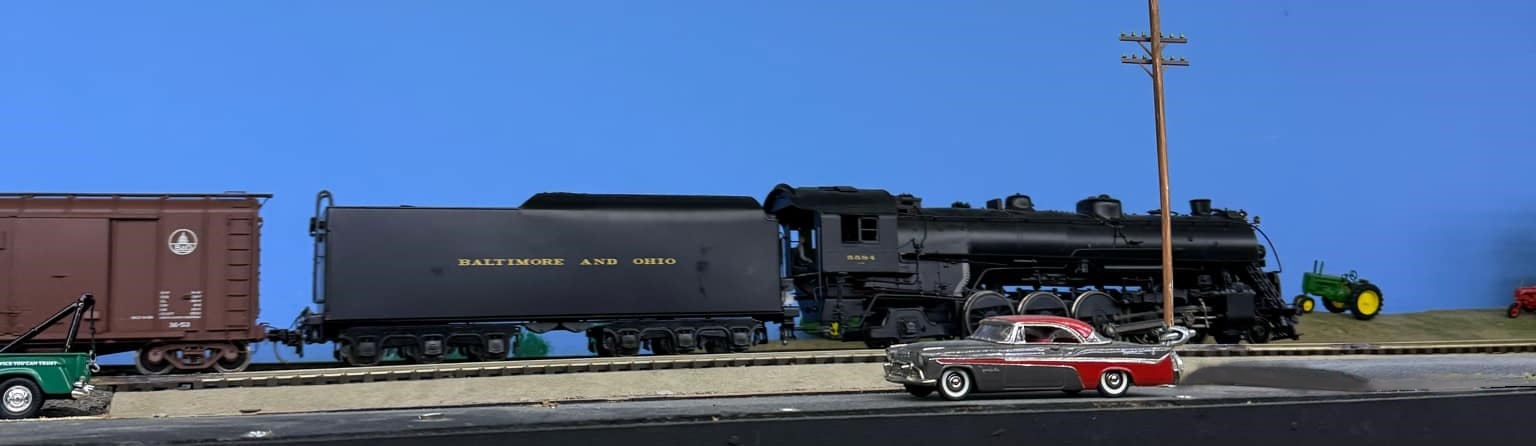
The locomotive in this install is a Sunset/3rd Rail B&O T3a 5584. I use Soundtraxx Blunami decoders for installs. This decoder contains everything you need to run your engine. Blunami decoders don’t care where the power comes from; it just needs power since it’s controlled from your phone/tablet via an app. Think of this as a standard DCC install, just adding a battery system. The wiring from the decoder to the various speakers and lighting effects is the same as a track powered engine. Above, you can see how the components in the install are laid out.


One feature I really like about the Blunami decoders is that they are fully programmable from the app. The app’s interface is very easy to use with all changes saved in real time. This allows you to fine tune performance and sound characteristics very quickly. I’ve had issues programming DCC decoders through track before because of shorts, dirty track, and bad electrical pickups. The old method of altering CV’s and programming via a computer was a longer process that takes time better spend running trains.
The engine acts just like it’s rail powered counterpart, just more consistent. The lighting effects are nice and bright as seen above. The sound is nice and clear with no artifacts. It’s fun to watch clients run their engines, especially when it passes over a section of track that it used to have issues on.
For me, the main draw of the hobby is to operate trains as realistically as possible, and track power just gets in the way of that. From constantly having to clean the wheels and rails, to worrying about maintaining insulators and power districts, track power just took away the fun of the hobby. The ease of access to batteries and these Blunami decoders makes track power is no longer the most practical option for train control, especially for modelers who are just starting out.
